 Home
Home

 July 23, 2026
 8 minute read
 Implement Schema Markup to Improve AI Understanding
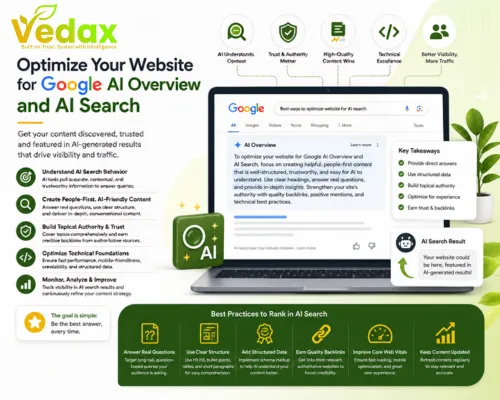
If your traffic graphs have looked a little strange since last year — impressions holding steady but clicks quietly sliding — you’re not imagining it. Google AI Overview, ChatGPT search, Perplexity, and Gemini are now answering questions directly, often without a single click to your site. For businesses in Ahmedabad, Mumbai, Bangalore, and beyond, this shift means traditional SEO alone is no longer enough. Ranking well in classic blue links matters, but getting cited inside an AI-generated answer is quickly becoming the new front page of the internet. This article breaks down, in practical terms, how Indian businesses can adapt their websites for this new reality.
Why Choose Vedax for AI Overview and AI Search Optimization?
Vedax Agency has spent years working across local SEO Ahmedabad, technical SEO, and content strategy for clients across India, the USA, UK, and Europe, and over the last two years that work has naturally extended into AEO (Answer Engine Optimization) and GEO (Generative Engine Optimization). This isn’t a separate discipline bolted onto old SEO — it’s an evolution of the same fundamentals: clear structure, factual accuracy, strong entity signals, and content that genuinely answers a question.
Vedax approaches AI Overview optimization the way a good editor approaches a manuscript — not by chasing algorithm tricks, but by making sure every page has a clear point of view, is easy for machines to parse, and earns its place in an answer. A digital marketing agency in Ahmedabad working with local manufacturers, D2C brands, and service businesses sees firsthand how AI Overviews change what “ranking #1” even means — sometimes the win isn’t the top blue link anymore, it’s being the source Google’s AI chooses to quote.
Our AI Search Optimization Capabilities
Yes, we provide a structured approach that covers both the technical and content sides of AI visibility:
- Semantic content architecture – organizing pages around topics and entities, not just keywords, so AI models understand what your business actually does.
- Structured data implementation – Article, FAQPage, Product, LocalBusiness, and Organization schema so crawlers and AI models can extract facts cleanly.
- Answer-first content formatting – short, direct answers near the top of a page, followed by depth, because AI Overview tends to pull concise, well-framed statements.
- Entity and citation building – Wikipedia, Google Business Profile, LinkedIn, industry directories, and press mentions that reinforce who you are, since AI models weigh corroborated facts heavily.
- Technical SEO services – crawlability, page speed, mobile rendering, and clean HTML, because a page an AI crawler can’t parse properly won’t get cited, no matter how good the writing is.
- Multi-platform visibility tracking – monitoring how a brand appears (or doesn’t) across Google AI Overview, ChatGPT, Perplexity, and Gemini responses, not just traditional rank trackers.
A textile exporter in Surat, for instance, benefits differently from AI search than a boutique clinic in Vadodara — the queries, intent, and competitive landscape are different, so the content strategy has to be built around the specific business, not a generic checklist.
Navigating Quality Standards & Technical Accuracy
The best AI Overview optimization work respects a simple truth: AI models are increasingly good at detecting thin, recycled, or exaggerated content, and they tend to avoid citing it. That means the old habit of stuffing keywords or publishing shallow “500-word SEO articles” actively works against a brand now.
Technical accuracy matters more than ever. If a page states a wrong statistic, an outdated price, or a vague claim without support, AI systems are less likely to treat it as a reliable source. Here’s how Vedax approaches this — every claim is checked against a primary source, every page is reviewed for factual consistency, and structured data is validated so there’s no mismatch between what’s written and what’s marked up. For a Chennai-based SaaS company or a Hyderabad healthcare provider, this discipline is non-negotiable — AI systems are particularly cautious about medical, financial, and legal content (Google’s YMYL guidelines apply here too), so E-E-A-T signals like author credentials, citations, and clear sourcing carry real weight.
Local Agencies vs Vedax: What the AI-Search Era Demands
| Capability | Typical Local SEO Agency | Vedax |
|---|---|---|
| Traditional keyword-based SEO | Yes | Yes |
| AEO / GEO / AIO strategy for AI Overview, ChatGPT, Perplexity, Gemini | Rarely offered | Core focus area |
| Structured data (Schema.org) depth | Basic, often incomplete | Full Article/FAQ/LocalBusiness/Organization coverage |
| Entity & citation building | Limited | Structured entity-building process |
| Cross-market experience (India, USA, UK, Europe) | Usually single-market | Multi-market experience |
| Integrated PPC + SEO + AI visibility reporting | Siloed teams | Integrated reporting |
This isn’t about one type of agency being universally better — plenty of local agencies do solid traditional SEO. The distinction is specialization: AI search optimization is still new enough that many agencies haven’t built dedicated processes for it yet.
Step-by-Step Process – How We Deliver AI Overview Optimization
- Audit – Reviewing current AI Overview and AI-platform visibility, schema coverage, content depth, and technical crawlability.
- Entity mapping – Documenting the brand’s core facts (services, locations, credentials, pricing logic) consistently across the website and third-party sources.
- Content restructuring – Rewriting key pages with answer-first paragraphs, clear headings, and supporting depth, following technical SEO services best practices.
- Schema implementation – Adding and validating structured data across priority pages.
- Citation and PR building – Securing mentions on credible third-party sites, since AI models weigh independent corroboration.
- Monitoring – Tracking appearances (or absence) in AI Overview and other AI-generated answers monthly, and iterating.
Businesses in Pune, Jaipur, Indore, and Chandigarh typically see the clearest early wins on FAQ-style and comparison content, since AI Overview leans heavily on pages that already answer a question in a structured way.
Real Client Case Study
(Illustrative scenario based on typical project patterns — client name anonymized; replace with a verified, named case study before publishing.)
Consider a mid-sized B2B manufacturing client based in Ahmedabad, exporting industrial components to buyers in the USA and Europe. Their website ranked reasonably on Google for core keywords but was almost invisible in AI Overview answers and ChatGPT responses for comparison-style buyer queries. The initial audit found three gaps: no structured FAQ content, thin product specification pages, and no third-party citations beyond their own directory listing.
Over a focused engagement, the team restructured product pages around direct buyer questions, added FAQPage and Product schema, and built a handful of credible industry citations. Within a few months, the client began appearing as a cited source in AI Overview answers for several export-related queries, alongside a measurable increase in qualified inbound inquiries from international buyers. The lesson for most Indian B2B and D2C businesses is the same: AI Overview visibility rewards clarity and structure far more than volume of content.
Frequently Asked Questions
1. What is Google AI Overview and how is it different from regular search results?
- Google AI Overview is an AI-generated summary that appears above traditional search results, synthesizing information from multiple sources to answer a query directly, often reducing the need to click through to a website.
2. How is AEO different from traditional SEO?
- Traditional SEO focuses on ranking pages in a list of links; AEO focuses on getting content cited or quoted directly within AI-generated answers, which requires clearer structure, stronger factual accuracy, and answer-first writing.
3. Does schema markup actually help with AI Overview visibility?
- Structured data doesn’t guarantee inclusion, but it makes it significantly easier for AI systems to extract accurate facts about a business, which supports citation likelihood.
4. Can small and mid-sized businesses in India compete for AI Overview visibility?
- Yes — AI Overview often favors clear, well-structured, niche-specific content over generic large-site content, which can actually work in favor of focused local or regional businesses.
5. How long does it take to see results from AI search optimization?
- Most businesses start seeing measurable shifts in AI-platform visibility within 8–12 weeks, though this varies by industry competitiveness and existing content quality.
6. Is AI Overview optimization only relevant for Google, or does it help with ChatGPT and Perplexity too?
- The same fundamentals — clear structure, factual accuracy, and strong entity signals — improve visibility across Google AI Overview, ChatGPT, Perplexity, and Gemini, since all of them prioritize well-corroborated, clearly written sources.
7. Do I need to redesign my entire website for AI search optimization?
- No — most improvements are content and structure changes on existing pages (headings, schema, answer-first paragraphs) rather than a full rebuild.
Getting started: If you’re unsure where your website currently stands with AI Overview and AI search platforms, Vedax Agency offers a Free SEO & Digital Marketing Consultation to review your current visibility. You can also request the SEO Cost & Package Guide for a clear breakdown of what AI search optimization typically involves, or message the team directly on WhatsApp at 88660 36337 for a quick visibility check.